Building a Protein Variant Classifier with ESM2 and Multi-GPU Training
Building a protein variant classifier with ESM2: clinical metric selection, a difference-vector architecture, class imbalance, and multi-GPU DDP.
Introduction
In the field of clinical genomics, accurately predicting whether a specific genetic variant is pathogenic (disease-causing) or benign is a critical challenge. Recently, I worked on a project to develop a deep learning model that classifies protein variants as either Gain-of-Function (GOF) or Loss-of-Function (LOF) using ESM2 (Evolutionary Scale Modeling), a state-of-the-art protein language model.
This post covers two related but distinct tasks with different label spaces, so it is worth separating them up front to avoid conflating their labels:
- Task A — Pathogenic-variant prioritization & metric selection. A binary
pathogenic (LABEL=1)vsbenign (LABEL=0)problem, used to evaluate and choose among existing pathogenicity predictors. (Covered in Challenge 1.) - Task B — GOF/LOF classifier training. A separate binary
GOFvsLOFproblem over the variants of interest, where we train our own ESM2-based model. (Covered in Challenges 2-4.)
The two tasks share a class-imbalance theme but do not share labels: a “positive” in Task A is a pathogenic variant, whereas a “positive” in Task B is the minority GOF class.
Challenge 1 (Task A): Metric Selection for Clinical Use
Before diving into the model, I had to evaluate existing pathogenicity predictors. The dataset contains 107 patients, each with multiple variants where only a few are pathogenic (LABEL=1).
The Problem: Class Imbalance
The data is highly imbalanced—most variants are benign (LABEL=0), only a few are pathogenic (LABEL=1). This makes metric selection critical.
| Metric | Formula | Problem with Imbalanced Data |
|---|---|---|
| Accuracy | (TP+TN) / Total | Predicting all as benign gives high accuracy |
| AUROC | Area under TPR-FPR curve | Can look good even with poor precision |
Why AUROC Alone Is Not Enough
AUROC measures discrimination across all thresholds. A model with AUROC=0.94 sounds great, but:
- At what threshold does it achieve good Precision and Recall?
- In clinical diagnostics, False Negatives are dangerous (missing a pathogenic variant)
Metrics for Clinical Pathogenicity Prediction
For this problem, I focused on both classification metrics and ranking metrics:
Classification Metrics (Binary)
| Metric | Formula | Clinical Importance |
|---|---|---|
| Recall (Sensitivity) | $\frac{TP}{TP + FN}$ | Must be high: we cannot miss pathogenic variants |
| Precision (PPV) | $\frac{TP}{TP + FP}$ | Reduces unnecessary follow-up tests |
| F1 Score | $\frac{2 \times Precision \times Recall}{Precision + Recall}$ | Balances both for imbalanced data |
Ranking Metric (Patient-Centric)
Since each patient has multiple variants and we want the pathogenic variant to be ranked high:
| Metric | Formula | Clinical Importance |
|---|---|---|
| Hit@K | $\frac{\text{# eligible patients with a pathogenic variant at rank }\le K}{\text{# eligible patients}}$ | Measures how often at least one pathogenic variant appears in the top K ranks |
The formal definition:
\[\text{Hit@K} = \frac{1}{N} \sum_{i=1}^{N} \mathbb{1}[\exists v \in P_i:\operatorname{rank}(v) \leq K]\]Where:
- $N$ = number of patients
- $P_i$ = the set of known pathogenic variants for patient $i$
- $\operatorname{rank}(v)$ = descending score rank, using the minimum rank for tied scores
- $\mathbb{1}[\cdot]$ = indicator function (1 if true, 0 if false)
This patient-level binary success rate is Hit@K, not variant-level recall. The distinction matters when a patient has multiple pathogenic variants. Ties at the K boundary are included rather than broken by input row order, so a tie can produce more than K returned rows.
Why Recall Is Critical
In a validated clinical workflow, a False Negative (ranking a truly pathogenic variant too low) may:
- delay follow-up or confirmatory analysis,
- reduce the chance that a relevant variant is reviewed promptly.
The downstream effect depends on disease, evidence, review workflow, variant actionability, and clinician judgment; this classifier does not directly prescribe treatment. Recall or Hit@K should therefore be emphasized alongside precision and workload, not maximized without a deployment-specific trade-off analysis.
Evaluation Framework
I evaluated each predictor (A, B, C) with both classification and ranking metrics:
1
2
3
4
5
6
7
8
9
10
11
12
13
14
15
16
17
18
19
20
21
22
23
24
25
26
27
28
29
30
31
32
33
34
35
36
37
38
39
40
41
42
43
44
45
46
47
48
49
50
51
52
53
54
55
from sklearn.metrics import (
    precision_recall_curve,
    precision_recall_fscore_support,
    roc_auc_score,
)
import numpy as np
import pandas as pd

def select_f1_threshold(y_true_val: np.ndarray, y_scores_val: np.ndarray) -> float:
    """Choose an operating threshold on validation data only."""
    precisions, recalls, thresholds = precision_recall_curve(y_true_val, y_scores_val)
    f1_scores = 2 * precisions[:-1] * recalls[:-1] / (
        precisions[:-1] + recalls[:-1] + 1e-8
    )
    return float(thresholds[np.argmax(f1_scores)])
# end def

def evaluate_predictor(
    y_true_test: np.ndarray,
    y_scores_test: np.ndarray,
    threshold: float,
) -> dict:
    """Evaluate a validation-selected threshold on untouched test data."""
    y_pred = (y_scores_test >= threshold).astype(int)
    precision, recall, f1, _ = precision_recall_fscore_support(
        y_true_test,
        y_pred,
        average="binary",
        zero_division=0,
    )
    return {
        "auroc": roc_auc_score(y_true_test, y_scores_test),
        "f1": f1,
        "recall": recall,
        "precision": precision,
        "threshold": threshold,
    }
# end def

def compute_top_k_hit(df: pd.DataFrame, score_col: str, k: int) -> float:
    """Compute tie-inclusive patient-level Hit@K."""
    if k <= 0:
        raise ValueError("k must be positive")

    patient_hits = []
    for _, group in df.groupby("Patient_ID"):
        if not group["LABEL"].eq(1).any():
            continue
        ranks = group[score_col].rank(method="min", ascending=False)
        patient_hits.append(bool((group["LABEL"].eq(1) & ranks.le(k)).any()))
    # end for
    if not patient_hits:
        raise ValueError("no patients with a pathogenic variant")
    return float(np.mean(patient_hits))
# end def
The threshold-selection and test-evaluation calls must use different patients (or, at minimum, a group-disjoint split). Selecting the best F1 and reporting it on the same 107 patients is an exploratory upper estimate, not a deployable operating point.
Results
Classification Metrics (Exploratory Same-Set Threshold Scan)
The original comparison below selected each predictor’s best-F1 threshold on the same 107-patient dataset used for reporting. It is useful for hypothesis generation, but it is optimistically biased; a clinical claim requires a patient-disjoint validation set for threshold selection and an untouched test cohort for the final table.
| Predictor | AUROC | Best F1 | Recall @ Best F1 | Precision @ Best F1 |
|---|---|---|---|---|
| A | 0.94 | 0.42 | 0.65 | 0.31 |
| B | 0.88 | 0.58 | 0.82 | 0.45 |
| C | 0.91 | 0.51 | 0.71 | 0.40 |
Ranking Metrics (Patient-Centric, Tie-Inclusive)
| Predictor | Hit@1 | Hit@5 |
|---|---|---|
| A | 12% | 35% |
| B | 24% | 52% |
| C | 18% | 41% |
Key Findings:
- Predictor A had the highest AUROC but the worst F1, Recall, and Hit@K metrics
- Predictor B achieved 82% exploratory Recall and 52% Hit@5 on this dataset, meaning at least one known pathogenic variant ranked within the top five for 52% of eligible patients
Exploratory decision: Predictor B is the candidate to carry into a disjoint validation because it had:
- Highest Recall (minimizes missed pathogenic variants)
- Best F1 Score (balanced performance on imbalanced data)
- Best Hit@5 (at least one pathogenic variant is within the top five ranks for 52% of patients)
This table does not establish a clinical operating point: the threshold was tuned and evaluated on the same cohort, confidence intervals are absent, and Hit@K does not measure how many pathogenic variants were missed when a patient has more than one.
Lesson: In medical AI with class imbalance, evaluate using multiple metrics that reflect clinical consequences—not just AUROC.
Challenge 2 (Task B): Modeling Protein Variants with ESM2
The core task was to classify variants using esm2_t33_650M_UR50D.
Existing vs. Proposed Approach
A standard approach in this domain often involves feeding the mutant sequence directly into the model to predict its property.
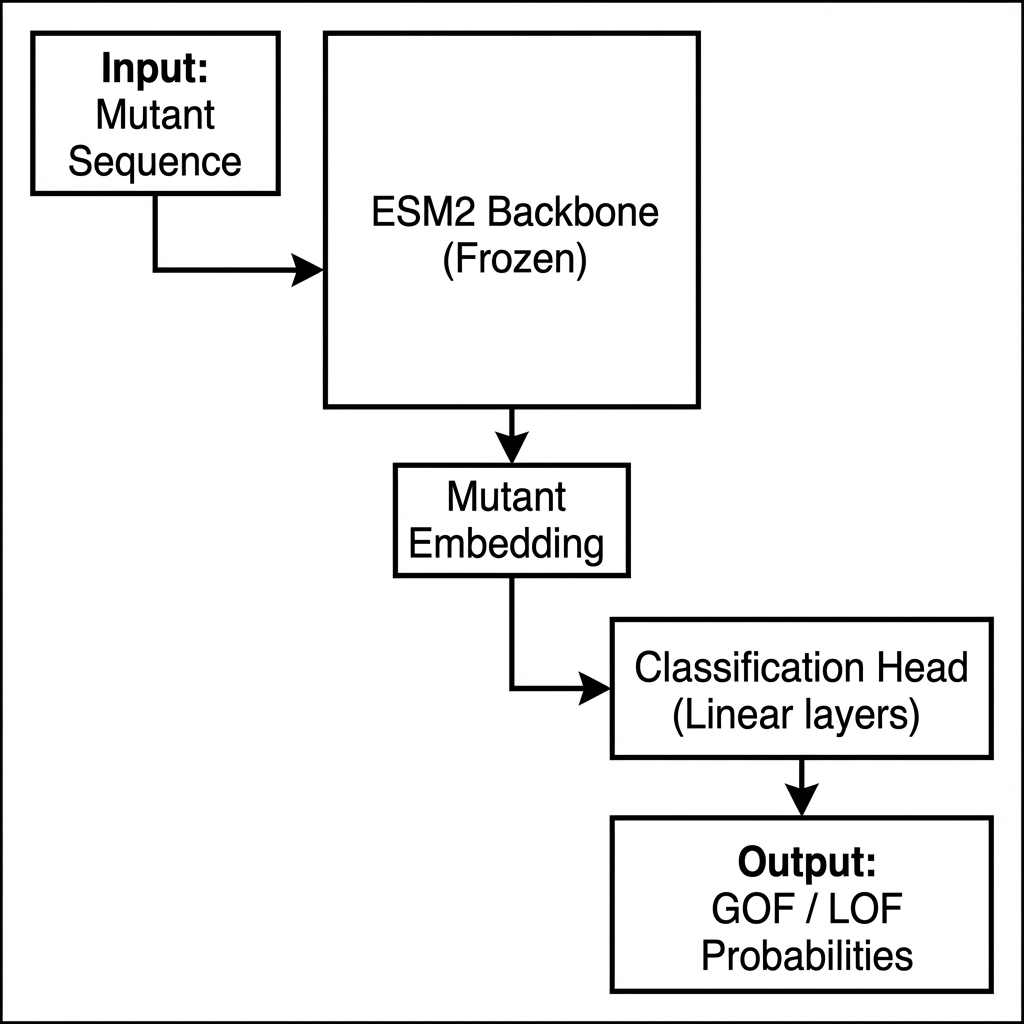 Figure 1: Standard Baseline Approach. The model only sees the mutant sequence, making it difficult to learn the specific impact of the mutation relative to the wild-type.
However, simply feeding the mutant sequence isn’t enough. The model needs to understand what changed. I designed the input to explicitly capture the difference:
1
Input = Concat(E_wt, E_mut, E_mut - E_wt)
- E_wt: Embedding of the Wild-Type sequence
- E_mut: Embedding of the Mutant sequence
- Difference: The vector representing the direction of change (Mutant - Wild-Type)
This “Difference Vector” was a key design choice in my experiments for distinguishing between LOF (function loss) and GOF (function gain).
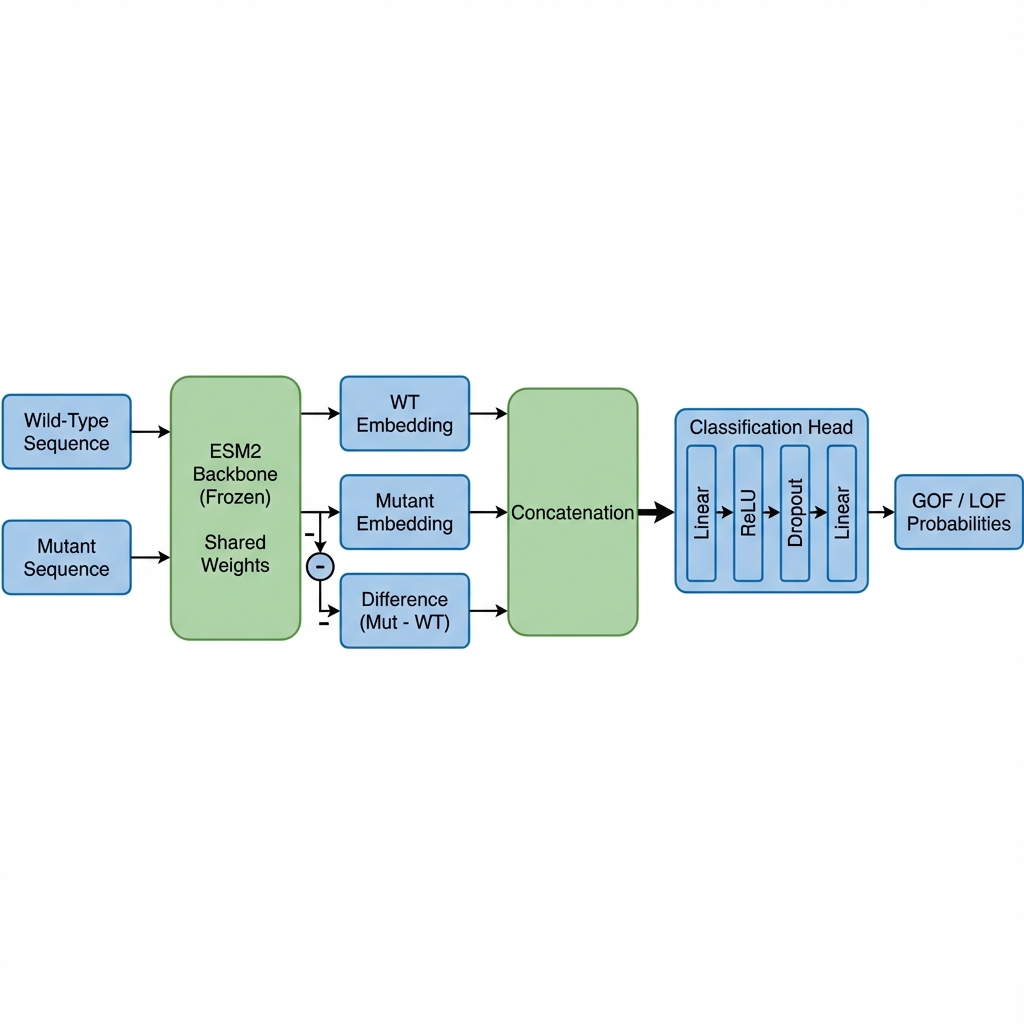 Figure 2: Our Proposed Architecture. By explicitly feeding the difference vector (Mutant - WT), the model can directly focus on the functional shift caused by the variant.
Code Snippet: Model Architecture
1
2
3
4
5
6
7
8
9
10
11
12
13
14
15
16
17
18
19
20
21
22
23
24
25
26
27
28
29
30
31
32
import torch
import torch.nn as nn
from transformers import EsmModel

class ESM2VariantClassifier(nn.Module):
    def __init__(self, model_name="facebook/esm2_t33_650M_UR50D"):
        super().__init__()
        self.esm = EsmModel.from_pretrained(model_name)
        # Freeze backbone for efficiency
        for param in self.esm.parameters():
            param.requires_grad = False

        hidden_size = self.esm.config.hidden_size

        self.classifier = nn.Sequential(
            nn.Linear(hidden_size * 3, 512), # 3x input size due to concatenation
            nn.ReLU(),
            nn.Dropout(0.3),
            nn.Linear(512, 2)
        )

    def forward(self, wt_ids, wt_mask, mut_ids, mut_mask):
        wt_out = self.esm(input_ids=wt_ids, attention_mask=wt_mask)
        mut_out = self.esm(input_ids=mut_ids, attention_mask=mut_mask)

        wt_cls = wt_out.last_hidden_state[:, 0, :]
        mut_cls = mut_out.last_hidden_state[:, 0, :]

        diff = mut_cls - wt_cls
        combined = torch.cat((wt_cls, mut_cls, diff), dim=1)

        return self.classifier(combined)
Here I pool each sequence using the CLS token (last_hidden_state[:, 0, :]); a common alternative is mean-pooling the hidden states over the non-special (non-CLS/EOS/padding) tokens, which can yield a more stable whole-sequence representation when the CLS token is not specifically trained as a summary.
Challenge 3 (Task B): Extreme Class Imbalance
This imbalance is on Task B’s GOF/LOF label space (distinct from the pathogenic/benign labels of Task A). The dataset had a 9:1 imbalance (90% LOF, 10% GOF). A standard model would simply predict “LOF” for everything and achieve 90% accuracy, which is useless.
Solution: Weighted Loss
I used CrossEntropyLoss with class weights inversely proportional to the class frequencies.
1
2
3
4
5
6
7
8
import torch
import torch.nn as nn

device = torch.device("cuda" if torch.cuda.is_available() else "cpu")

# LOF (0): 90%, GOF (1): 10%
class_weights = torch.tensor([0.1, 0.9]).to(device)
criterion = nn.CrossEntropyLoss(weight=class_weights)
This forces the model to pay 9x more attention to the minority GOF class, preventing it from being ignored.
Challenge 4 (Task B): Distributed Training on A100s
To utilize 4x NVIDIA A100 GPUs, I used PyTorch’s DistributedDataParallel (DDP).
Key implementation details:
DistributedSampler: Ensures each GPU gets a different slice of data.init_process_group: Sets up communication between GPUs.torchrun: The launcher utility to manage processes.
One useful pre-cluster check is a CPU smoke test of the data/model path. It is not a single-GPU DDP test: in the later public implementation, selecting gloo explicitly forces the device to CPU. The real 4xA100 run used nccl, which PyTorch recommends for distributed GPU training.
The original coursework used a different private training script. A later public reimplementation is available at commit 6b8bcd5; its runnable one-process distributed CPU smoke path is:
1
2
3
4
5
# Current public implementation: one-process distributed CPU smoke test
git checkout 6b8bcd57a4964f1f788f96fb934ae485986c5f25
torchrun --standalone --nproc_per_node=1 code/train_esm_classifier.py \
    --backend gloo --use_mock_data --epochs 1 --batch_size 2 \
    --max_len 64 --output_dir /tmp/pvc-ddp-smoke
The current script reads LOCAL_RANK from torchrun, and its gloo branch deliberately selects CPU. This checks process-group and DDP plumbing, but it is not validation of CUDA/NCCL behavior or the historical four-GPU result.
What Didn’t Work / Limitations
This was a small-scale study, so the results are a proof of concept rather than a validated clinical tool:
- Tiny, reused evaluation set. Task A’s predictor comparison uses 107 patients with only a few pathogenic variants each, and the best-F1 threshold was selected on the same cohort used for reporting. The AUROC/F1/Hit@K gaps therefore carry both wide uncertainty and selection bias; no confidence intervals or significance tests are reported.
- Frozen backbone. ESM2 is used purely as a feature extractor (backbone frozen, only the head trained), which caps how much variant-specific signal the model can capture; fine-tuning or LoRA was not compared.
- Static class weighting only. The 9:1 GOF/LOF imbalance is handled with fixed inverse-frequency weights; resampling, focal loss, and threshold calibration were not benchmarked against it.
- Pooling not ablated. CLS-token pooling is used; as noted above, mean-pooling may give a more stable representation, but the two were not compared head-to-head.
- No external validation. Generalization to other cohorts and a leakage-safe held-out split (so variants from the same patient don’t span train/test) are not established here.
Conclusion
This project reinforced the importance of domain-specific feature engineering (Difference Vector) and robust engineering practices (DDP, Weighted Loss) when working with biological data. By combining pre-trained PLMs with thoughtful architecture, we can build powerful tools for genomic analysis.
Setup (for reproducibility). Model:
facebook/esm2_t33_650M_UR50D(HuggingFacetransformers, backbone frozen). Hardware: 4× NVIDIA A100, PyTorchDistributedDataParallel(nccl) launched withtorchrun. Data: 107 patients (Task A); ~9:1 LOF/GOF split (Task B). The original coursework checkout remains private; the linked public repository is a later implementation, not provenance for every historical command or result.