[Troubleshooting] Your FID of 0.24 Isn't Near-Perfect — It's the Wrong Feature Space
A text-to-image GAN reported FID 0.2423 because pytorch-ignite's default used 1000-d logits, not the canonical 2048-d pool3 features. Re-evaluation produced a much larger small-N estimate, with important sample-size limits.
Introduction
I inherited an evaluation notebook for a text-to-image GAN. It reported FID 0.2423 and IS 1.86, and since FID is lower-is-better, 0.24 reads like a near-perfect generator.
That is precisely the problem. Published face-GAN FIDs are commonly in the single digits to tens, usually with much larger evaluation sets and a specified pipeline. Those values are not direct benchmarks for our N=510 run, but they make 0.24 incompatible with the visibly blurry samples and worth auditing before interpretation.
It was. This post walks through why pytorch-ignite’s default FID returns a tiny, non-canonical number, demonstrates the feature-space effect on the same images, flags a second comparison bug, and shows a corrected implementation. It also separates fixing the extractor from a stronger claim the data cannot support: with only 510 samples, the replacement FID is still a noisy, biased estimate.
Setup. The model is a multi-stage CLIP-guided GAN trained on an MM-CelebA-HQ subset, on a single RTX 4060 Ti (8 GB). Evaluation uses 510 real and 510 generated images. In a 2048-d feature space, a 510-sample covariance has rank at most 509, so the absolute FID has substantial finite-sample bias. The dataset is licensed, so no generated faces are shown here.
The Symptom: An Impossibly Good FID
- Expected: an FID in the literature range (single digits for excellent, tens for mediocre) that tracks sample quality.
- Actual: FID 0.2423, while the samples were clearly low quality.
- Reproduction: the notebook computed FID with pytorch-ignite’s metric, constructed with no feature extractor:
1
2
3
from ignite.metrics import FID

fid_metric = FID(device=idist.device())   # the bug is hidden in this default
- Environment:
pytorch-ignite, InceptionV3 weights downloaded by ignite, single CUDA device.
A score of 0.24 implies the two Gaussians FID compares are nearly coincident. The samples said otherwise. So the question is not “why is the model so good” — it is “what is this number actually measuring.”
Root Cause: ignite’s Default FID Uses 1000-d Logits, Not 2048-d pool3
FID is the Fréchet distance between two Gaussians fit to Inception features:
\[\text{FID} = \lVert \mu_r - \mu_f \rVert^2 + \operatorname{Tr}\!\left(\Sigma_r + \Sigma_f - 2\left(\Sigma_r \Sigma_f\right)^{1/2}\right)\]The subtlety lives in the word features. The canonical FID (Heusel et al., 2017) uses the 2048-dimensional pool3 activations of InceptionV3. But “Inception features” is a choice, and ignite makes a different one by default: with no feature_extractor argument, FID(device=...) falls back to ignite’s InceptionModel wrapper, whose default output is the 1000-dimensional classification logits (num_features=1000).
A Fréchet distance computed in a 1000-d classification-logit space and one computed in the 2048-d pool3 space are simply different metrics. The logit space is differently scaled and semantically transformed, so the distances can differ by orders of magnitude. The 1000-d value must not be compared with canonical pool3 FIDs.
flowchart LR
    I["Generated / real image"] --> N["InceptionV3"]
    N --> L["1000-d logits<br/>(ignite FID default)"]
    N --> P["2048-d pool3<br/>(standard FID)"]
    L --> A["FID approx 0.18<br/>not comparable"]
    P --> B["FID approx 165<br/>canonical extractor, N=510"]
The kicker: the pytorch-ignite GAN-evaluation tutorial the notebook was based on does build a custom 2048-d wrapper around InceptionV3 and passes it as feature_extractor=.... The notebook copied the FID(...) call but dropped the wrapper, silently inheriting the 1000-d default.
Proof: Same Model, Two Scales (and No Conversion)
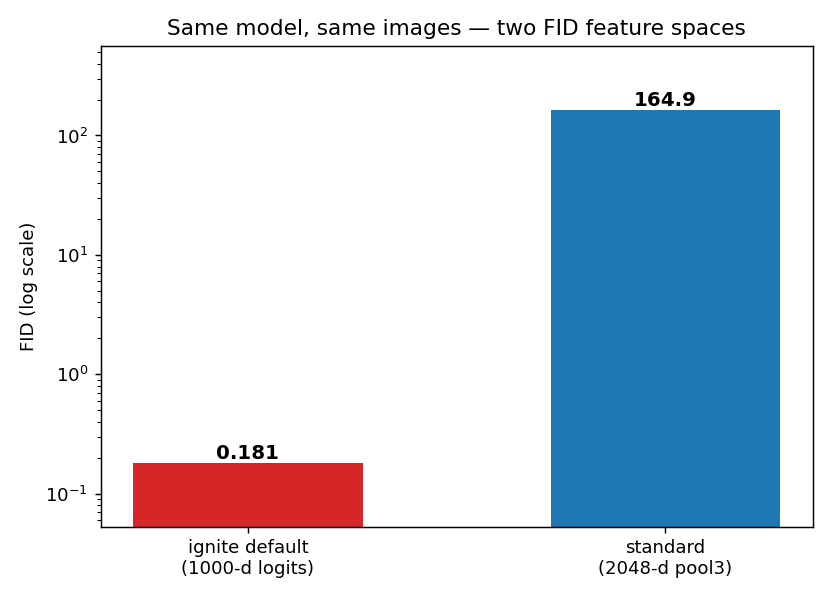
To show this is the metric and not the model, I took our shipped best checkpoint, generated one fake per test image, conditioned on that image’s first stored caption embedding (510 test images, 510 fakes — the dataset stores up to ten captions per image and this demo uses only the first), and scored the same fakes and reals two ways — ignite’s default and the standard 2048-d FID:
| Inputs | ignite default (1000-d logits) | standard (2048-d pool3) |
|---|---|---|
| fakes vs real | 0.181 | 164.9 |
| same real set vs itself (identity smoke test) | −0.000 | — |
Same generator, same 510 image pairs — only the Inception feature space differs. The 1000-d default reports 0.181; the canonical 2048-d extractor reports 164.9. Scoring the identical real tensor set against itself returns approximately zero, which checks the accumulator’s identity path but not the validity of the full preprocessing pipeline.
Two things to read off this:
- 0.18 is the same tiny scale as the original 0.2423. The notebook’s “near-perfect” number was this 1000-d artifact all along. Recomputed with the canonical extractor, this checkpoint’s historical N=510 estimate is ~165, and the original notebook model re-scores to approximately 205. These are high internal estimates, not directly comparable to large-sample published scores.
- You cannot convert one into the other. There is no fixed multiplier: on an earlier run, the 2048-d / 1000-d ratio was 1343× at one epoch and 1870× at another. The ratio depends on the distributions, so the canonical value must be recomputed from images.
The same-set identity result needs a narrow interpretation. Any deterministic feature extractor, including the wrong one, should return approximately zero when fed the exact same samples through the exact same path. A useful pipeline control also compares independent real splits processed through the same loading/resize/range path and checks behavior after intentionally perturbing one side.
A Second Bug: All Fakes From One Prompt
Even with the right extractor, the notebook’s comparison was invalid. Its generate_images_batch(128) produced all 128 fakes from a single fixed caption, then compared them against real images spanning the whole test set. That pits a one-point fake distribution against a broad real distribution (with a real/fake value-range mismatch on top). FID is a distribution-to-distribution distance; the fakes have to be drawn from the same caption distribution as the reals, or the number is meaningless before the feature space even enters the picture.
The Fix: Standard 2048-d FID, Fakes Per Caption
Use torchmetrics with feature=2048 stated explicitly, accumulate over the whole test set, and condition each fake on its real caption:
1
2
3
4
5
6
7
8
9
10
11
12
13
14
15
import torch
from torchmetrics.image.fid import FrechetInceptionDistance

fid = FrechetInceptionDistance(feature=2048, normalize=False).to(device)  # uint8 [0,255]
to_u8 = lambda x: (x.clamp(0, 1) * 255).to(torch.uint8)

with torch.no_grad():
    for real, captions in test_loader:                       # real in [0,1]
        fid.update(to_u8(real.to(device)), real=True)
        z = torch.randn(captions.size(0), noise_dim, device=device)
        fake = (generator(captions.to(device), z).clamp(-1, 1) + 1) / 2   # tanh [-1,1] -> [0,1]
        fid.update(to_u8(fake), real=False)
    # end for
# end with
print(f"standard FID = {fid.compute().item():.2f}")
A couple of details that bite people: pass normalize=False and feed uint8 [0, 255] (as above), or pass normalize=True and feed float [0, 1] — mixing them (uint8 into normalize=True) silently corrupts the score. And FrechetInceptionDistance resizes to 299×299 internally, so don’t pre-resize.
Those are the implementation traps; the input pipeline has its own, quantified by clean-fid (Parmar et al., CVPR 2022):
- Resize backend. PIL-bicubic vs OpenCV/PyTorch bilinear shifts FID by ~4 on real FFHQ (0 baseline → ~4.3) and ~4.5 on StyleGAN2 samples (2.98 → 7.45). Resize reals and fakes the same way.
- JPEG round-trip. Exporting samples as JPEG-75 instead of PNG moved real FFHQ FID to ~21 (8-bit PNG quantization alone is <0.01). Never save generated images as JPEG before scoring.
- Sample count. FID is a biased estimator whose bias is model-dependent (Chong & Forsyth, CVPR 2020), so comparing two models at different N can flip their ranking. Fix N and report it.
Holding the extractor, resize path, format, and N constant makes comparisons better specified. It does not make this historical 164.9 bitwise reproducible: the demo drew latent noise without recording an evaluation seed, and N=510 leaves substantial sampling variation.
On this historical draw it returned 164.9 — a high canonical-extractor estimate, not the uniquely “real” FID of the model. It is useful for checkpoint selection only when N, captions, evaluator code, preprocessing, checkpoint, and latent seeds are held fixed; repeated sampling seeds or KID should accompany close comparisons.
The audited source is commit 6fac9ec. Update (2026-07). At the time of writing, 6fac9ec was the head of the pushed branch fix/correctness-audit; that branch has since advanced (c50baaa, 1076caa) and merged into main via PR #1 (0548b72); main has since advanced further to 2dee0b1 via a later, separate PR, so main no longer matches this snapshot — check out 6fac9ec by SHA, not by branch name, to reproduce it. Scripts in that repository import project-root modules, so direct invocations need export PYTHONPATH="$(pwd)". The feature-space demo itself still needs an explicit latent seed before its exact generated sample set can be reproduced.
Lesson: the metric object’s defaults are part of the metric. If you didn’t choose the feature extractor, you don’t know what you measured.
Even the Right Extractor Has Limits
Fixing 1000-d logits → 2048-d pool3 aligns the feature definition with canonical FID. Direct literature comparison still requires a matched implementation and sample count; N=510 is far below common large-sample evaluations and yields a rank-deficient covariance estimate. Even after matching those conditions, the Inception-V3 pool3 backbone is trained on ImageNet, which creates a separate domain-validity limitation:
- Kynkäänniemi et al. (ICLR 2023) show FID’s feature space is so close to ImageNet classification that you can lower FID with no quality gain by aligning generated images’ top-N ImageNet-class histograms — an ImageNet-pretrained FastGAN can match StyleGAN2’s FID while looking worse to humans. CLIP features largely resist this.
- Stein et al. (NeurIPS 2023) — the largest human-realism study to date — found no common metric strongly correlates with human judgment, blaming over-reliance on Inception-V3, and propose FD-DINOv2; CMMD (CVPR 2024) makes the same case and proposes a CLIP-MMD distance.
For a non-ImageNet domain like faces, that is another caveat on our number: 164.9 is a historical small-N estimate using the canonical extractor, while KID across repeated draws and an FD-DINOv2 cross-check would provide complementary evidence. Since MS-CLIP-GAN conditions on CLIP text features, a CLIP-based distance may share representation bias; DINOv2 is a more independent second view.
Conclusion / Key Takeaways
- The feature space is part of FID. Confirm you are on the 2048-d
pool3features; a metric library’s default extractor is not guaranteed to be the standard one (ignite’s default is the 1000-d logits). - A suspiciously tiny FID requires an audit, not celebration. Verify the extractor, input range, sampling distribution, and accumulator before interpreting it. Published ranges are only diagnostic context unless N and the full pipeline match.
- Fix the comparison before the extractor. Generate fakes from the real caption distribution and match input ranges, or the number is invalid no matter which features you use.
- The canonical extractor is not sufficient. Report N and evaluation seeds, treat same-set real-vs-real as an identity smoke test, add independent controls, and use repeated draws or KID when N is small. Cross-check domain validity with a more independent representation such as DINOv2.
Resources
- Source snapshot — audited
fix/correctness-auditcommit6fac9ec - FID — Heusel et al., GANs Trained by a Two Time-Scale Update Rule Converge to a Local Nash Equilibrium, NeurIPS 2017 (arXiv:1706.08500)
- torchmetrics —
FrechetInceptionDistance(2048-d pool3 by default) - pytorch-ignite —
FIDmetric and the GAN-evaluation tutorial that builds the custom 2048-d extractor - Input-pipeline pitfalls — Parmar et al., On Aliased Resizing and Surprising Subtleties in GAN Evaluation (clean-fid), CVPR 2022 (arXiv:2104.11222); Chong & Forsyth, Effectively Unbiased FID and Inception Score, CVPR 2020 (arXiv:1911.07023)
- The backbone itself — Kynkäänniemi et al., The Role of ImageNet Classes in Fréchet Inception Distance, ICLR 2023 (arXiv:2203.06026); Stein et al., Exposing flaws of generative model evaluation metrics, NeurIPS 2023 (arXiv:2306.04675); CMMD, CVPR 2024 (arXiv:2401.09603)
- Next in this series — before interpreting the training curves, map the model being measured: “MS-CLIP-GAN Architecture: How a CLIP-Guided Multi-Stage GAN Is Wired”.