How to Actually Report FID: A Single-GPU Reproducibility Checklist
A reusable protocol for auditing and reporting FID: pin the extractor, input pipeline, sampling, seeds, checkpoint, controls, and sample-size limits, while recording missing provenance honestly.
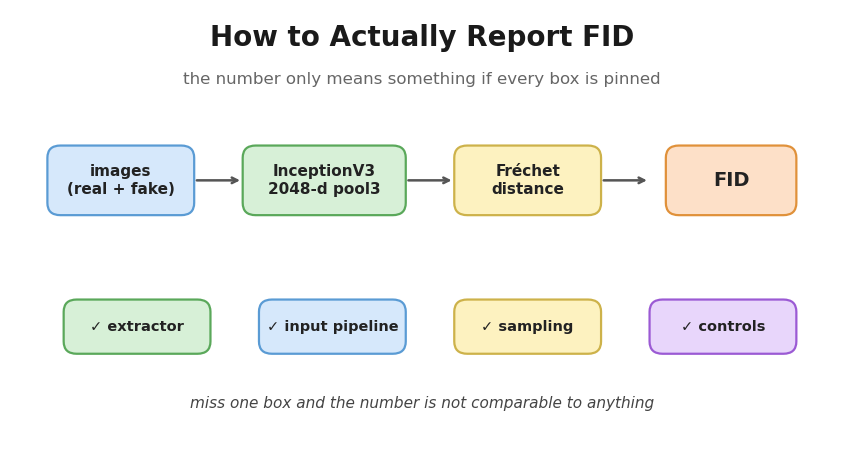
Why a checklist
Across this series, the first requirement was to fix the FID feature definition. An earlier post caught a generator reported at “FID 0.24” because the metric used the wrong feature space; the canonical-extractor re-evaluation was approximately 205 at N=510. That correction made internal comparisons meaningful, but it did not remove finite-sample bias or missing evaluation-seed provenance. Later posts use those estimates as exploratory same-N evidence, not definitive causal measurements.
The lesson generalizes past that one bug: FID is a single scalar with several silent knobs. Reproducibility requires pinning all of them; comparability additionally requires a compatible implementation, preprocessing path, sample distribution, and sample count. This checklist also records missing provenance instead of retroactively inventing it.
What FID is, in one line
FID is the Fréchet distance between two Gaussians fit to Inception features of real and generated images:
\[\text{FID} = \lVert \mu_r - \mu_f \rVert^2 + \operatorname{Tr}\!\left(\Sigma_r + \Sigma_f - 2\left(\Sigma_r \Sigma_f\right)^{1/2}\right)\]Every knob below is just a way that “Inception features of real and generated images” can quietly mean something different in your code than in the paper you’re comparing to. (The feature-space derivation lives in the first post; here we make it operational.)
The four things that silently move FID
flowchart LR
    I["images<br/>real + fake"] --> E["extractor<br/>2048-d pool3"]
    E --> D["Fréchet distance"]
    D --> N["FID"]
    K1["① extractor"] -.-> E
    K2["② input pipeline"] -.-> I
    K3["③ sampling"] -.-> I
    K4["④ controls"] -.-> N
Feature extractor — use 2048-d
pool3, and log it. The standard FID uses InceptionV3’s 2048-d pool3 activations. Library defaults are not guaranteed to be that (pytorch-ignite’s default is the 1000-d logits — the original bug). One line of insurance:1 2 3 4 5
from torchmetrics.image.fid import FrechetInceptionDistance fid = FrechetInceptionDistance(feature=2048, normalize=False) # 2048-d pool3, uint8 inputs print("FID feature extractor: InceptionV3 pool3 / 2048-d") # end
Input pipeline — resize backend, format, range/dtype. clean-fid (Parmar et al., CVPR 2022) quantifies the traps: PIL-bicubic vs OpenCV/PyTorch bilinear shifts FID by ~4–7; exporting samples as JPEG instead of PNG pushed real FFHQ FID to ~21. Match the resize for real and fake, never JPEG-round-trip generated images, and match range/dtype to the FID flag (uint8
[0,255]withnormalize=False, or float[0,1]withnormalize=True— not mixed). Details and numbers in the first post.Sampling — same N, the right distribution, accumulate over the full set. Generate fakes from the real caption/label distribution (one fake per real test item — e.g. one per test image, conditioned on that image’s caption), not a single fixed prompt. Accumulate over the whole test set and
compute()once — never average per-batch FIDs. Fix N and report it: FID is a biased estimator whose bias is model-dependent (Chong & Forsyth, CVPR 2020), so comparing models at different N can flip the ranking. Here N=510 is smaller than the 2048 feature dimension, so each empirical covariance has rank at most 509; close differences need repeated draws and a small-sample complement such as KID.Controls and provenance — identity, independent splits, seeds, checkpoint, code. Scoring the exact same real tensor set against itself should be approximately zero, but that is only an identity/accumulator smoke test: a wrong deterministic extractor also passes it. Add a comparison between independent real splits that traverse the real loading pipeline, and a deliberately perturbed-input check when debugging preprocessing. Record the training seed, evaluation latent seed, checkpoint hash/path, evaluator commit, and library version separately.
A worked example (our own numbers, no new run)
Why trust these four knobs? Because they explain every FID surprise in this series — on one RTX 4060 Ti (8 GB), one model, no new experiments:
| evidence | what it shows | knob |
|---|---|---|
| ignite-default = 0.18, standard 2048-d = 164.9 (same model, same images) | the extractor alone moves FID ~900× | ① extractor |
| same real tensors vs themselves = ≈ 0.0 | the accumulator identity path behaves; full-pipeline validity remains untested | ④ controls |
| baseline 163 → DiffAugment 118.5 | one matched-horizon run gives a promising same-N difference | (exploratory payoff) |
The canonical-extractor estimate moved in the same direction as the unshared visual inspection in this run, unlike the tiny 1000-d number. That makes it more useful, but does not establish that the model “actually got better” by a known amount: the visual check was not blinded, the training was not repeated, and the historical evaluator did not record its latent seed.
A reporting table you can copy
Put this next to any FID you publish. The example deliberately exposes the missing historical provenance rather than filling it with the configured training seed:
| field | example value |
|---|---|
| feature extractor | InceptionV3 pool3, 2048-d |
| FID implementation | torchmetrics FrechetInceptionDistance; version not recorded |
| resize | library-internal → 299×299 (no pre-resize) |
| image format | PNG (no JPEG round-trip) |
| input range / dtype | uint8 [0,255], normalize=False |
| samples N | 510 real / 510 fake, full-set accumulation |
| fake conditioning | one fake per test image, conditioned on that image’s first stored caption (not every caption, not a fixed prompt) |
| training/data-split seed | 42 |
| evaluation latent seed | not recorded for historical JSON |
| checkpoint | diffaug100, epoch_90 (raw local checkpoint, not promoted) |
| evaluator source | result introduced at f64515f; audited branch 6fac9ec |
| historical FID estimate | 118.5 |
| control: same real tensors vs themselves | ≈ 0.0 (identity smoke only) |
| control: independent real splits | not reported |
Because the historical evaluation latent seed and distributable checkpoint are missing, this table documents a historical result rather than a fully re-derivable artifact. Branch origin/fix/correctness-audit at 6fac9ec adds a run-level seed, but it does not reset or reuse noise per checkpoint: changing the epoch list changes later checkpoints’ inputs. Fix that by resetting a dedicated generator per checkpoint or precomputing fixed latent tensors; then re-evaluate the old checkpoints.
Update (2026-07). This is fixed and merged. That branch advanced (
c50baaa,1076caa) and merged intomainvia PR #1 (0548b72);mainis now at2dee0b1.experiments/eval_curve.pycallsseed_fix(seed)after loading each checkpoint (not once before the loop), so a checkpoint’s generated sample stream is invariant to which other epochs are in the same invocation; the module docstring now states the RNG “is reset after loading every checkpoint.” The old checkpoints were re-evaluated under this fix (seeexperiments/RESULTS.md).
Direct script calls also need export PYTHONPATH="$(pwd)".
The limits even a clean FID has
Pinning the knobs can make a run reproducible; it does not automatically make it comparable or statistically precise. At N=510, report the result as a same-N estimate, repeat the fake draw, and add KID or another small-sample analysis. The 2048-d pool3 backbone is also ImageNet-trained: Kynkäänniemi et al. (ICLR 2023) show FID is gameable by aligning ImageNet-class histograms, and Stein et al. (NeurIPS 2023) show it under-tracks human realism, recommending FD-DINOv2; CMMD (CVPR 2024) proposes CLIP-MMD. For faces, add an FD-DINOv2 cross-check. A CLIP-based metric is less independent here because the model itself uses CLIP conditioning.
The checklist
1
2
3
4
5
6
7
8
9
10
11
12
[ ] extractor = 2048-d pool3 (NOT logits) — print num_features
[ ] real and fake resized the same way; don't pre-resize (library does 299 internally)
[ ] PNG, not JPEG; range/dtype matches the FID flag (uint8+normalize=False OR float[0,1]+normalize=True)
[ ] fakes from the real caption/label distribution, not one fixed prompt
[ ] fixed N, accumulate over the full set, compute() once — report N and whether N < feature dimension
[ ] same-set real-vs-real identity smoke ≈ 0; do not call it full-pipeline validation
[ ] independent real splits and an intentional preprocessing perturbation behave as expected
[ ] training seed and evaluation latent seed recorded separately
[ ] exact checkpoint + evaluator commit + library version recorded
[ ] small N? repeat fake draws and add KID/uncertainty analysis
[ ] report extractor + library + N alongside the number
[ ] non-ImageNet domain? add a CLIP-FID / FD-DINOv2 cross-check
And it’s not just FID
None of this is specific to generative models. A detector’s mAP has the same disease: in a parallel self-audit, a “0.91 mAP” turned out near-train because the “held-out” split shared clips with training — a sampling bug, the detection analogue of “fakes from one prompt.” The general law: a single-scalar metric is a compression of the truth, and the compression artifacts live in the pipeline. That cross-domain pattern is the subject of the capstone.
Resources
- FID — Heusel et al., NeurIPS 2017 (arXiv:1706.08500)
- Input-pipeline pitfalls — clean-fid, Parmar et al., CVPR 2022 (arXiv:2104.11222); unbiased FID, Chong & Forsyth, CVPR 2020 (arXiv:1911.07023)
- Backbone limits — Kynkäänniemi et al., ICLR 2023 (arXiv:2203.06026); Stein et al., NeurIPS 2023 (arXiv:2306.04675); CMMD, CVPR 2024 (arXiv:2401.09603)
- Tools — torchmetrics FID, clean-fid, torch-fidelity
- Series — the bug this distills: “Your FID of 0.24 Isn’t Near-Perfect”