Held-Out in Name Only: Two Leaks and a Confound in My Detector's Evaluation
My safety-gear detector reported 0.91 mAP and a −93% false-positive cut. Then I audited my own evaluation and found three validity problems — two data leaks and a seed confound — that make both numbers softer than they sound. Here's the one I'd actually trust.
Introduction
In an earlier post I reported some strong numbers for a construction-site safety-gear detector: 0.91 mAP on the held-out validation set, and up to −93% fewer false positives (on an in-domain probe) after adding empty-GT negatives. Good numbers — so I went back and tried to break them before trusting them.
I found three problems in my own evaluation, and none is a code bug. Two are data leakage — the setup quietly let the model be measured on data too close to what it trained on — and the third is a seed confound that made a tiny delta look firmer than it is. This post is the honest correction: what each one is, how big it is, and which number actually survives scrutiny.
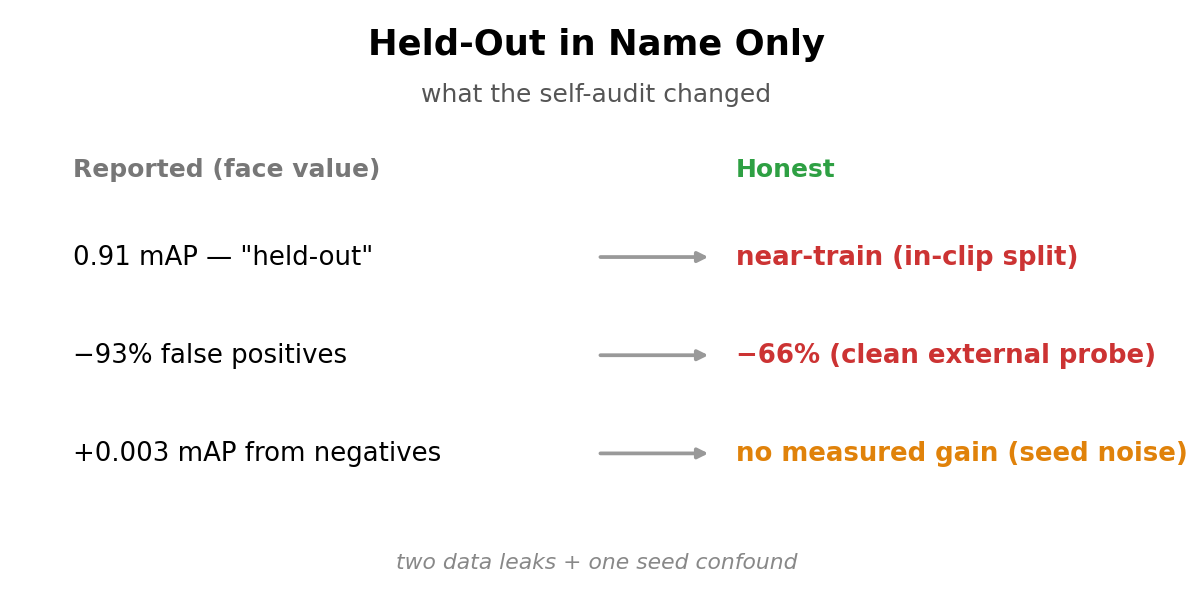
The short version:
| Reported number | Taken at face value | Verdict | How to cite it |
|---|---|---|---|
| val mAP 0.908 / 0.911 | held-out generalization | 🔴 near-train (Leak 1) | say “AIHub official in-clip split” |
| in-domain FP −93% (314→22) | FP suppression | 🔴 probe overlaps training (Leak 2) | rename “training-distribution suppression” |
| external FP −66% (61→21) | out-of-domain generalization | ✅ uncontaminated (tiny probe) | the cleanest estimate here (only 6 frames) |
| +neg mAP +0.003 | accuracy gain | 🟠 within seed noise (Confound 3) | read as “no measured loss” only |
Leak 1: the “held-out” validation set shares clips with training
AIHub 507 ships an official Training/Validation split, and I used Validation as a held-out test set “never seen in training.” That is true per frame — and false per clip.
The split doesn’t separate clips; it interleaves frames within the same clip. In the source archive, a single fixed-camera clip’s frames are dealt out alternately: _0001/_0003 to train, _0002/_0004 to val.
flowchart LR
    A["_0001"] --> B["_0002"] --> C["_0003"] --> D["_0004"]
    A --> TR["train split"]
    C --> TR
    B --> VL["val split"]
    D --> VL
Within one clip, frames alternate between the train and val splits — so most val frames sit between two of their own clip’s training frames (quantified just below).
Re-measuring the actual JSON files (train 56,150 / val 6,984):
| Measure | Value |
|---|---|
| Distinct clips | 55 in train and the same 55 in val (0 val-only clips) |
| val frames within ±1 label-index of a train frame | 94.2% (6,579) |
| val frames within ±2 | 99.1% |
One honest caveat in the other direction: that “±1” is the label-file index, not a 33 ms video frame. Labels are sparsely sampled, so adjacent indices can be seconds apart, not milliseconds (in the one clip I checked, the median Δ at index-distance 1 was ~4.8 s). So it isn’t literally the same frame twice — but it is the same fixed camera, same worker, same violation scene, a few seconds apart. Distributionally that’s near-identical.
So 0.908 / 0.911 mAP is near-train accuracy, not held-out generalization. That also explains why the model’s false-positive behavior degraded on truly external footage (YouTube) and on a different site (New_Sample) — the validation number never measured that gap. This is a property of AIHub’s official split, not a bug in my extraction.
The fix I didn’t do (yet): a clip-disjoint group split — partition by clip ID (raw_data_ID), e.g. 45 train / 10 val clips, stratified by scenario, so no clip spans both sides. I expect the honest headline to land meaningfully below 0.91.
Leak 2: the false-positive probe overlaps the training negatives
The −93% came from a 50-frame in-domain probe of compliant workers: how many false boxes the baseline vs the negative model emit. The catch: those probe frames overlap the empty-GT negatives I trained on. Comparing by file hash:
| Comparison | Overlap |
|---|---|
| A/B run — model B’s 2,250 negatives vs the 50-frame probe | 26/50 byte-identical (model A: 0) |
| Full-scale — 26,855 negatives vs the 50-frame probe | 8/50 byte-identical, and 50/50 within ≤6 frames of a training negative |
The −93% is the full-scale RTMDet-m run, whose negatives overlap that probe directly (the full-scale row above). (The smaller RTMDet-tiny A/B cut, −55%, is even more overlapped — 26/50 byte-identical.) So a large part of both is in-training-distribution suppression (partial memorization), not out-of-domain generalization. The number that isn’t contaminated is the external YouTube probe — −66% (61→21 boxes) — which shares nothing with training. That’s the cleanest, uncontaminated number in this audit — though, as noted next, it’s a tiny 6-frame probe, so read it as directional too.
The probes are also statistically thin: the 50 in-domain frames come from effectively 2 clips, and the 6 external frames from 1 video. And the 0.3 score threshold is the visualizer’s default, an uncalibrated operating point — so differences in each model’s score distribution leak into the raw FP count.
The fix: hold out negative clips (not frames) for the probe, and use a few hundred frames. And since a compliant-only probe has no positives, you can’t read recall off it — fix the score threshold on a separate clip-disjoint set that does contain real violations (or report a FROC curve — false positives per image vs. recall — over that mixed set), then count this probe’s false positives at that fixed operating point, instead of an arbitrary 0.3.
A subtler version of the same leak: the
val_neg.jsonI used for a “penalty-included” mAP draws its 13,357 negative frames from the same 303 clips as the training negatives (median frame distance 2). So that cross-check isn’t independent either — it includes partial memorization.
Confound 3: no fixed seed, so small deltas are noise
Unlike the first two, this one isn’t data leakage — it’s an experimental confound — but it inflated my confidence in a tiny delta just the same.
MMDetection 3.3.0’s tools/train.py has no seed flag, and I never set randomness in the config — so every run drew a random seed. The seeds that actually ran:
| Run | Seed |
|---|---|
| baseline-m | 66114966 |
| neg-m | 142584584 |
| A/B exp_A / exp_B | 1626408629 / 1429965293 |
Two consequences:
- My “controlled” A/B (negatives on vs off) also differed in seed, so it wasn’t a clean controlled experiment.
- A mAP delta of ±0.003 (0.908 → 0.911) is within what I’d treat as plausible run-to-run variance. The right reading is “adding negatives cost no measured accuracy,” not “+0.003 improvement.”
Importantly, this cuts only the small deltas. The false-positive effects (−66% / −93% / −55%) are large — far bigger than the mAP wobble — and unlikely to be explained by seed alone (though I didn’t measure FP-count variance across seeds). The available runs consistently show negatives reducing false positives; I just can’t quantify it to the last point from one run.
The fix: set the seed via --cfg-options randomness.seed=0 randomness.deterministic=True (the deterministic flag costs some speed) so reruns are comparable.
Bonus: the headline mAP is a flattering average
Even setting leakage aside, the single “0.908 mAP” macro-averages two box granularities of the same violation: a small part box (WO, e.g. the bare head) and a large whole-worker box (UA). The easy whole-worker classes (AP ~0.93–0.94) pull the average up; the harder part boxes sit at 0.875 / 0.880. If you care about localizing the part, quote the per-class AP, not the headline.
There’s a second decomposition the headline hides: COCO also averages over object size — AP-small / AP-medium / AP-large (areas below 32², 32²–96², above 96² px). This dataset has no COCO-small objects — AP-small comes back as -1 (undefined) — and the hook and whole-worker boxes are large, so AP-large (0.909) is what carries the headline. The soft bucket is AP-medium, at 0.438, and it is not the hooks: it is dominated by the bare-head part box (helmet_off_head), which shrinks to ~21 px at the 640×640 input, plus a two-sample helmet_off_person outlier at 0.0. So the size caveat is real, but it lives in AP-medium, not AP-small — report AP-medium next to the headline, and the fix when it lags is usually input resolution and assignment, not blindly deepening the head.
What the honest numbers are
- Detection accuracy: “0.908 / 0.911 mAP on AIHub’s official in-clip validation split” — near-train; a clip-disjoint number would be lower.
- False positives, out-of-domain: −66% — the cleanest, uncontaminated probe (but only 6 frames) — not −93%.
- Effect of negatives on detection: “no measured loss” (the +0.003 is seed noise).
- A/B direction: valid — negatives reduce false positives — but the magnitude is directional, not a calibrated rate.
How not to fool yourself (the reusable part)
- Split by the unit that leaks, not the unit you have. Frames from one clip aren’t independent; split by clip/patient/scene (group split), not by row.
- Keep evaluation probes disjoint from training — check by file hash, not by filename or folder.
- Fix the seed before reading small deltas, and separate “no loss” from “improvement.”
- Report an operating point or a curve, not a single uncalibrated threshold.
- Lead with the uncontaminated number. When two estimates disagree, the cleaner one (here, external −66%, with its 6-frame caveat) is the honest headline; the rosier one needs an asterisk.
These rules aren’t detection-specific. The same disease — a single scalar resting on an unstated pipeline assumption — shows up in generative metrics too: a misconfigured FID read 0.24, while one canonical-extractor N=510 draw for the same original model was ~205. That biased finite-sample estimate is diagnostic, not the uniquely “real” FID. The cross-domain pattern, and how to report a metric so it survives scrutiny, is the capstone.
Conclusion
The model is genuinely useful, and the negatives genuinely help — but my first numbers were softer than they read. The detector’s “held-out” set wasn’t clip-held-out, the false-positive probe overlapped training, and an unfixed seed blurred the small deltas. Re-labeling each number honestly (near-train mAP, external −66%, “no measured loss”) costs nothing and is the difference between a result you can stand behind and one that quietly oversells. The most useful thing I did for this project was try to break my own evaluation.
Resources
- Companion post: the detector and the false-positive fix these numbers came from
- Background: clip/group-disjoint splitting — scikit-learn
GroupKFoldandStratifiedGroupKFold— and Kaufman et al., Leakage in Data Mining (ACM TKDD, 2012) for the general failure mode — ACM · Semantic Scholar