When 0.91 mAP Still Fails: Fixing Safety-Gear False Positives with Empty-GT Negatives
A safety-gear detector scored 0.91 mAP yet fired 'helmet_off' on helmeted workers. Here is the diagnosis, and how empty-GT negatives cut external false positives by 66% with no measured loss on the AIHub in-clip validation mAP.
Introduction
I trained an RTMDet object detector to flag two safety violations on construction sites — no helmet and unhooked safety harness — using AIHub’s “high-altitude work site” video dataset (dataset 507). On AIHub’s official validation split — frame-held-out, but not clip-disjoint (more on that later) — it scored 0.908 mAP and 0.995 AP@50. By the usual reading, the problem was solved.
It was not. The same model fired helmet_off on workers who were clearly wearing white helmets, with 0.79–0.89 confidence. A 0.91-mAP detector was confidently wrong on the easiest possible case.
This post is about the gap between that number and reality: how I diagnosed the failure (and ruled out the obvious explanation), why it traces back to a single data-extraction decision, and how adding empty-GT negatives cut external false positives by 66% with no measured loss on the (in-clip) validation mAP. The headline lesson is the one this blog keeps relearning — a high mAP can hide the failure mode that actually matters.
Setup. Model: RTMDet-m (OpenMMLab MMDetection 3.3.0), fine-tuned from COCO weights at 640×640, batch 4, on a single RTX 4060 Ti (8 GB). Data: AIHub 507, 4 classes (helmet/harness × part-box/worker-box). This was a solo research project on a licensed dataset, so the dataset frames are not redistributed here; the numbers, configs, and snippets below are the reproduction cues.
Challenge 1: A Detector That Looked Solved
The dataset labels every violation at two box granularities — a small part box (WO, e.g. the bare head) and a large whole-worker box (UA). That gives four training classes:
| id | class | meaning | box |
|---|---|---|---|
| 1 | helmet_off_head | no helmet | head / part (small) |
| 2 | hook_off_part | harness unhooked | part (small) |
| 3 | helmet_off_person | no helmet | worker (large) |
| 4 | hook_off_person | harness unhooked | worker (large) |
I extracted the ~63k frames containing these classes (~10% of the dataset; 56,150 train + 6,984 validation), fine-tuned RTMDet-m for 12 epochs (~10 h), and evaluated on the 6,984-frame official validation split (frame-held-out, not clip-disjoint):
| Metric | Value |
|---|---|
| mAP (IoU 0.50:0.95) | 0.908 |
| AP@50 | 0.995 |
| AP@75 | 0.990 |
Here mAP is the COCO primary metric, $\text{mAP} = \text{AP}$ averaged over IoU thresholds $0.50{:}0.05{:}0.95$. Per class, AP ranged from 0.875 (helmet_off_head) to 0.944 (helmet_off_person). At IoU 0.50 every class sat at 0.99–1.00. (That single mAP also macro-averages the harder part boxes, ~0.88, with the easy whole-worker boxes, ~0.93–0.94, so the headline is pulled up by the easy granularity — the per-class spread is the honest view.) Whether a worker is in violation was, on this validation set, essentially solved.
Lesson: AP@50 at 0.99 tells you the model separates the labeled classes well — it says nothing about what the model does on inputs the labels never contained.
Challenge 2: It Fires on Compliant Workers
To sanity-check generalization, I pulled six frames from a YouTube construction-safety clip (a distribution the model never trained on) and ran inference. The result was not a subtle degradation:
- In all 6 of 6 frames, the model emitted
helmet_off_personon a worker who was wearing a helmet, at 0.79–0.89 confidence. - Across the six frames it produced 61 false-positive boxes total.
- Harness violations: zero false positives — the failure was specific to the helmet classes.
A detector that scores 0.995 AP@50 in-distribution and hallucinates “no helmet” on a helmeted worker is not a small calibration issue. Something about what the model learned to do when it sees a worker was wrong.
flowchart LR
    W["Helmeted, compliant worker<br/>6 of 6 YouTube frames"] --> M["RTMDet-m baseline"]
    M --> A["helmet_off_person 0.79-0.89<br/>61 false-positive boxes"]
    M --> B["harness classes<br/>0 false positives"]
The failure is helmet-specific: the baseline invents helmet_off on a helmeted worker while correctly raising no harness alarm.
Challenge 3: Is It Domain Shift? Reproducing the Failure In-Domain
The convenient explanation is domain shift — YouTube footage looks different from the training CCTV, so of course it breaks. If that were the complete explanation, the failure should depend on external footage. I tested whether domain shift was necessary for the failure before treating it as the sole cause.
Two facts argued against domain shift as a complete explanation:
- The model has seen plenty of helmets. Every harness-violation frame (~32k of them) contains a helmeted worker, labeled
hook_off. And on validation, the model distinguishes helmet-state from harness-state cleanly (helmet_off_person0.944 vshook_off_person0.932). It is not “blind to helmets.” - The failure reproduces in-domain. I ran the model on
New_Sample— the same fixed-CCTV style as training, helmeted compliant workers, no violation classes present. It still firedhelmet_offat 0.44–0.76 confidence, includinghelmet_off_headplaced directly on the helmeted head.
Reproducing the failure on same-domain footage shows that domain shift is not necessary for it: the model often fires on a worker with no violation, usually as helmet_off (harness false positives stayed at zero, so this is not a blanket “any worker → any violation” reflex). It does not show that domain shift contributes nothing to the larger YouTube error; the external and in-domain probes were not matched or large enough to estimate that contribution.
Challenge 4: The Leading Mechanism — Every Training Frame Had a Violation
The cause is upstream of the model, in the data extraction. To save disk and training time, I extracted only frames that contained one of the four violation classes. That decision has a subtle consequence:
flowchart TB
    A["AIHub 507: 619,718 labeled frames"] --> B["Extract only frames<br/>containing a violation class"]
    B --> C["Training set: every frame<br/>has at least one violation"]
    C --> D["Model can learn a shortcut:<br/>worker visible to emit a violation box"]
    D --> E["A zero-violation frame<br/>never appears in training"]
    E --> F["At inference, a compliant worker<br/>still gets a violation box = false positive"]
The model never saw a zero-violation frame — a worker present with no violation labeled. That makes a negative-space gap a strong causal hypothesis: the training objective never rewards producing no box for a compliant worker, and the validation set carries the same violation-only filter, so it cannot measure that false-positive rate. The intervention below supports this mechanism because adding empty-GT negatives sharply reduced false positives, but the one-run, non-disjoint design does not prove that this was the only cause or that helmet_off was chosen because it was easier to localize.
Lesson: A dataset filtered to “only frames with the target” never trains the zero-target case. If the model will see compliant workers in production, include representative compliant frames and evaluate them on a disjoint split.
Challenge 5: The Fix — Empty-GT Negatives
The prescription follows directly from the diagnosis: show the model compliant workers with no boxes to predict. In object detection these are empty-GT negatives — images whose ground truth is an empty annotation list. Because such an image has no foreground target to match, any box the model proposes there is trained toward background, pushing its scores on compliant workers down. The only catch is that detection frameworks discard annotation-less images by default; you have to keep them explicitly.
1
2
3
4
5
6
7
8
# configs/helmet_hook/rtmdet_m_helmet_hook_neg.py  (MMDetection config; overrides the RTMDet base)
train_dataloader = dict(
    dataset=dict(
        ann_file='train_neg.json',   # 56,150 positives + 26,855 compliant negatives
        # KEY: keep zero-annotation (compliant) frames — MMDetection 3.x filters them out by default
        filter_cfg=dict(filter_empty_gt=False, min_size=32),
    )
)
An empty-GT negative is just a COCO images entry with no matching annotations. Identifying them is a one-liner over the COCO file:
1
2
3
4
5
6
7
8
9
10
import json

def find_empty_gt_images(coco_path: str) -> list:
    """Return image ids that have zero annotations (compliant-worker frames)."""
    with open(coco_path) as f:
        coco = json.load(f)
    # end with
    annotated = {a["image_id"] for a in coco["annotations"]}
    return [img["id"] for img in coco["images"] if img["id"] not in annotated]
# end def
I sourced negatives from compliant-worker frames in the same sites (so they are hard negatives, not trivially easy ones), then validated the idea before scaling it.
First, a controlled A/B test (RTMDet-tiny)
Same architecture and schedule — the intended variable was the 2,250 empty-GT negatives added to model B (the seed was not pinned, so it varied too; see Limitations):
| val mAP | FP images (of 50) | FP boxes | helmet_off_head boxes | |
|---|---|---|---|---|
| A (no negatives) | 0.880 | 50 | 159 | 100 |
| B (+2,250 negatives) | 0.869 | 24 | 72 | 24 |
| change | −0.011 | −52% | −55% | −76% |
Adding negatives cut false-positive boxes by 55% while validation mAP barely moved (−0.011). Two caveats: (1) this A/B is RTMDet-tiny, so its absolute false-positive counts are lower than the full RTMDet-m run in the Results section (159 here vs 314 there for the same 50-frame probe); (2) these counts use the same in-domain probe that overlaps the training negatives, so read the A/B magnitude as directional — the clean cross-domain estimate is the YouTube −66% in the Results section. The direction was confirmed; the magnitude said “scale it up.”
Then, the full-scale run (RTMDet-m + 26,855 negatives)
flowchart LR
    P["Positive frames<br/>56,150 with violations"] --> T["train_neg.json"]
    N["Compliant frames<br/>26,855 empty-GT"] --> T
    T --> M["RTMDet-m<br/>filter_cfg(filter_empty_gt=False), 10 epochs"]
The full negative set (26,855 compliant frames, ~0.48× the positives) trained cleanly for 10 epochs. Validation mAP rose monotonically across epochs 4→10 — 0.895 → 0.901 → 0.906 → 0.911 — with the final gain realized in the cosine-decay tail (loss 0.30 → 0.23):
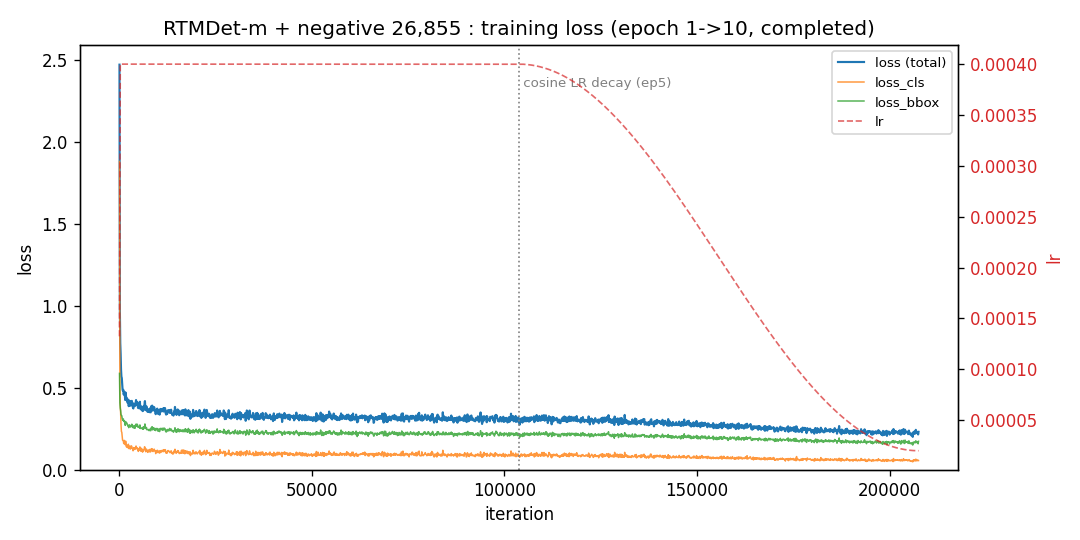 Training loss for the negative model. The flat fixed-LR region (~0.30) drops to ~0.23 once cosine decay kicks in (epochs 5–10), the same window where validation mAP climbs 0.906 → 0.911.
Results
The headline comparison is on the external YouTube probe — six frames I manually checked as fully compliant (workers wearing helmets) — because it is the only set with no overlap with training data (see Limitations). Every count below is boxes scoring above the 0.3 threshold; on a compliant frame, any such box is a false positive:
| Probe | Baseline (no neg) | + Empty-GT negatives | Reduction |
|---|---|---|---|
| External YouTube (6 compliant frames) | 61 boxes · 6 of 6 frames | 21 boxes · 6 of 6 frames | −66% |
In-domain New_Sample (50 frames) | 314 boxes · 50 of 50 | 22 boxes · 14 of 50 | −93% † |
† The in-domain −93% is a training-distribution suppression rate, not a generalization estimate — the probe overlaps the training negatives. See Limitations.
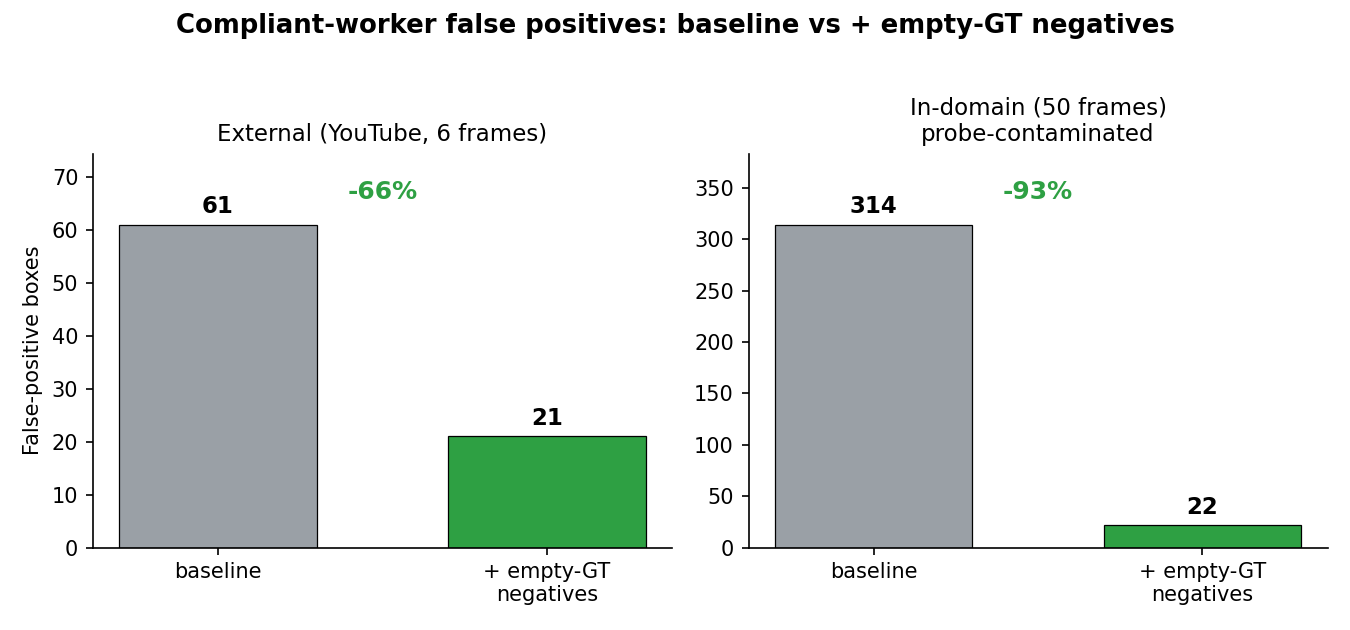 False-positive boxes, baseline vs + empty-GT negatives. The clean external probe (left) is the headline; the in-domain probe (right) is larger but contaminated. Independent y-axes.
And crucially, suppressing the false positives did not cost detection accuracy on real violations:
| Model | mAP | AP@50 |
|---|---|---|
| baseline RTMDet-m (12 ep) | 0.908 | 0.995 |
| + empty-GT negatives (10 ep) | 0.911 | 0.995 |
The 0.908 → 0.911 move is within run-to-run seed noise, so the honest reading is “detection held flat while false positives dropped by two-thirds,” not “+0.003 mAP.” Empty-GT negatives produced large false-positive suppression at this 0.3 threshold, with no measured cost to the (near-train) in-clip validation mAP; this probe did not measure precision or recall on compliant workers.
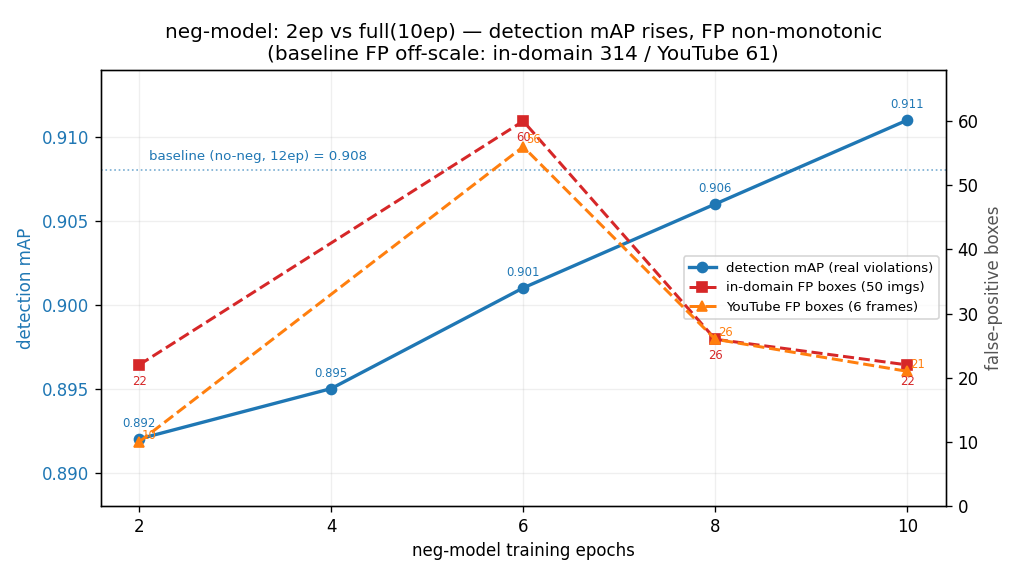
One counterintuitive result is worth showing, because it is a trap. Looked at per epoch, the earliest checkpoint seems to have the fewest false positives:
| neg checkpoint | det. mAP | in-domain FP (boxes/imgs) | YouTube FP (boxes/frames) |
|---|---|---|---|
| epoch 2 | 0.892 | 22 / 17 | 10 / 4 |
| epoch 6 | 0.901 | 60 / 27 | 56 / 6 |
| epoch 8 | 0.906 | 26 / 12 | 26 / 6 |
| epoch 10 | 0.911 | 22 / 14 | 21 / 6 |
Detection mAP (rising) vs false-positive count (non-monotonic) across epochs. Epoch 2’s low FP count is a mirage.
Epoch 2’s low false-positive count is consistent with an under-confident model: too few boxes clear the uncalibrated 0.3 threshold, and its detection mAP (0.892) is the worst of the run. Epoch 10 is the most defensible candidate among these four reported checkpoints because it has the highest in-clip mAP and fewer thresholded false positives than epochs 6 and 8. That table does not establish a globally optimal deployment checkpoint: selection should use a clip-disjoint mixed validation set, with either false positives compared at fixed recall or a FROC curve, followed by one untouched test evaluation.
What Didn’t Work / Limitations
This fix is real but partial, and two of the headline numbers need honest caveats.
- External transfer is incomplete. In-domain false positives nearly vanished, but the external YouTube probe still kept 21 boxes (−66%, not −100%). Every negative I added is from the AIHub domain, so it transfers only partially to out-of-domain footage. Fully closing the gap needs external-domain compliant negatives, which I do not have.
- The external result is a small sanity probe, not a benchmark. It is six frames from a single YouTube clip — enough to expose the failure and show the negatives clearly help, not enough to quantify a rate. Read the −66% as directional.
- 2,250 negatives were not enough. In the A/B run, some compliant frames — different sites, orange helmets the negatives under-covered — still drew
helmet_off. Negative diversity, not just count, matters. - The in-domain −93% is contaminated. The 50-frame in-domain probe overlaps the training negatives (some frames are byte-identical, all are within ≤6 frames of a training negative). So −93% is a training-distribution suppression rate, not generalization. This is exactly why I lead with the clean external −66%.
- Even the 0.91 mAP is near-train. AIHub 507’s official train/val split interleaves frames within the same clip — 94.2% of validation frames sit within ±1 label-index of a training frame from the same fixed-camera clip. So 0.908/0.911 reflects near-train performance, which is precisely why an external probe was able to expose a failure the validation set structurally could not. A clip-disjoint re-split would report a lower, more honest number — a future post in this series will dig into that.
- No fixed seed. MMDetection’s training does not fix a seed by default, so ±0.003 mAP deltas are within run-to-run variance — another reason to read the detection result as “no loss,” not “improvement.”
Conclusion
- A high mAP measures the labels, not the world. 0.995 AP@50 coexisted with confident
helmet_offcalls on helmeted workers, because the validation set shared the training set’s blind spot. Always probe the negative case the labels omit. - Reproduce the failure before explaining it. Seeing the false positive in-domain showed that domain shift was not required and raised the violation-only extraction filter as the leading mechanism; it did not rule out an additional external-domain effect.
- Empty-GT negatives are a cheap, targeted fix. Adding compliant frames with
filter_cfg(filter_empty_gt=False)cut external false positives 66% with no measured loss on the (near-train) validation mAP — but only as far as the negatives’ domain reaches, so diversity and clean, disjoint evaluation are the next requirements.
Reproduction
The dataset is licensed, so the frames are not redistributed here, but the evaluation is a handful of commands on the trained checkpoints — detection mAP (baseline and + negatives) through MMDetection’s test.py, and the compliant-worker false-positive counts through a small probe script:
1
2
3
4
5
6
7
8
9
10
11
12
13
14
15
16
17
# Baseline (no negatives) detection mAP — its config already evaluates val.json (6,984 frames)
python tools/test.py configs/helmet_hook/rtmdet_m_helmet_hook.py \
    work_dirs/helmet_hook/best_coco_bbox_mAP_epoch_12.pth

# + negatives model on the SAME 6,984 real-violation frames (val.json).
# Its config defaults to val_neg.json (20,341 frames incl. negatives), so override it:
python tools/test.py configs/helmet_hook/rtmdet_m_helmet_hook_neg.py \
    work_dirs/helmet_hook_neg/epoch_10.pth \
    --cfg-options test_dataloader.dataset.ann_file=val.json \
        test_evaluator.ann_file=$HOME/repo/datasets/helmet_hook_coco/val.json

# Compliant-worker false positives, baseline vs + negatives (in-domain + YouTube probes)
python scripts/measure_fp.py \
    --baseline-cfg configs/helmet_hook/rtmdet_m_helmet_hook.py \
    --baseline-ckpt work_dirs/helmet_hook/best_coco_bbox_mAP_epoch_12.pth \
    --neg-cfg configs/helmet_hook/rtmdet_m_helmet_hook_neg.py \
    --neg-ckpt work_dirs/helmet_hook_neg/epoch_10.pth
Resources
- RTMDet — RTMDet: An Empirical Study of Designing Real-Time Object Detectors, Lyu et al., 2022 (arXiv:2212.07784)
- Framework — OpenMMLab MMDetection (
configs/rtmdet/) - Dataset — AIHub 고소작업 현장 실시간 영상 데이터 (No. 507)
- Negatives / dataset bias — Liu et al., SSD: Single Shot MultiBox Detector (ECCV 2016) for hard-negative mining; Torralba & Efros, Unbiased Look at Dataset Bias (CVPR 2011)